Apocynaceae
String of hearts care
Ceropegia linearis subsp. woodii
Also called Ceropegia woodii, rosary vine, chain of hearts
Reviewed by Adnan Azam, M.Sc (Hons) Agri. Forestry · Updated November 24, 2026

- Light
- Bright to some direct
- Water
- Mostly dry
- Humidity
- Average to low
- Pets
- Non-toxic
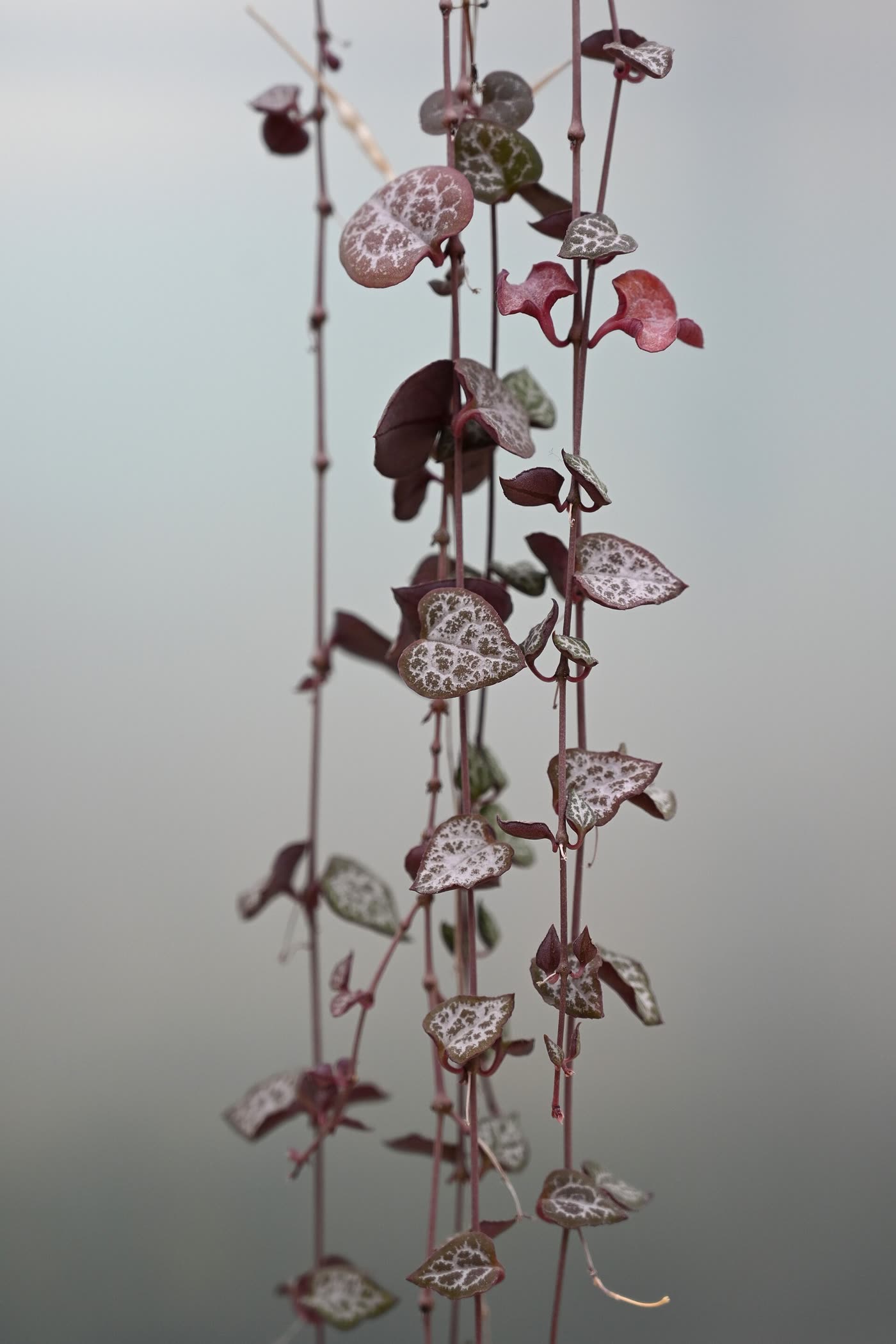
Bright light and a fast-draining mix. Water when the hearts fold slightly along the midrib and the soil is dry. It stores water in tubers. Generally non-toxic, unlike string of pearls. A dim shelf makes long bare strings.
Overview
String of hearts is the plant people buy when they want a trailer and a pet in the same room. Ceropegia woodii is listed as non-toxic. String of pearls is not. They are not interchangeable, even though both hang.
The leaves are semi-succulent and the plant makes tubers along the stems and under the soil. Those tubers are why it forgives a late watering. They are also why a weekly soak in a plastic pot rots it. Bright light keeps the purple backs of the leaves and the tight spacing.
Light
Bright light, with some direct sun if you acclimate it. A south or east window. In low light the hearts get farther apart, the purple fades, and the plant looks like a green thread. A grow light fixes a dark flat. Harsh unacclimated sun can bleach a heart. The silver patterning should stay crisp.
Water
Let the mix dry. The 'taco test' is useful: a thirsty heart folds upward along the vein. A flat, firm heart in dry-ish soil can wait. Water thoroughly and drain. The tubers rot if the pot stays wet, especially in winter. Bottom watering works if you do not leave the pot soaking. In a UK winter, this can be every three weeks or more.
Soil
A cactus or gritty houseplant mix in a pot with a hole. Shallow is better than deep. Terracotta is forgiving. Do not use a dense moisture-control compost. The tubers need air.
Humidity and temperature
Average to low. This is not a calathea. A steamy, dim bathroom fades it and invites rot. Dry air is fine.
18–28°C (65–82°F). Tubers store water. Cold wet soil does not.
Feeding
Diluted cactus fertilizer a few times in spring and summer. Feeding will not tighten a stretched vine. Light will. Overfeeding in low light makes soft growth that flops.
Repotting
Rarely, in spring, when the pot is packed with tubers. They like to be a little tight. A much larger pot stays wet. You can sit extra tubers on the mix and they may sprout. Do not bury them deep.
Propagation
Cut a vine, coil it on gritty mix so nodes touch, and pin it. Or remove a tuber and set it half on the soil. Stem cuttings root easily in bright light with the mix barely damp. A single heart with no node will not grow. Several strands per pot look finished sooner.
Through the year
Growth is fastest in long, bright days. Winter is a rest: more light if you can, much less water. Flowers — small lanterns — show up on bright plants. You do not need to deadhead for the plant's health. Cold windows and wet pots are the winter failure.
Pets and toxicity
The ASPCA lists Ceropegia woodii as non-toxic to cats and dogs. It is one of the better hanging plants if something might get batted. String of pearls, string of bananas, and pothos are not in that category. Read the label on the pot, not the shape of the leaf alone.
Problems on this plant
- leggy plants
Wide gaps between hearts are low light. The old stem stays sparse. New growth tightens in a brighter window.
- root rot
Black, soft stems at the soil and mushy tubers. Cut firm vines and re-root them.
- overwatering vs underwatering
Folded hearts and dry soil: water. Soft stems and wet soil: stop.
Do this in order
- Hang it in bright light. Purple leaf backs and close hearts are the sign you got it right.
- Use the taco test. Folded leaves plus dry mix means water. Flat leaves mean wait.
- Pot in grit. Tubers rot in dense, wet compost. A shallow clay pot is enough.
- Coil cuttings. Pin stems on mix so several nodes root, and you get a full pot.
Questions
Why is my string of hearts leggy?
Light. Move it to a brighter window or under a grow light. The bare sections will not fill in. New growth will be tighter, and you can cut the thin parts and re-root them.
How often should I water string of hearts?
When the mix is dry and the leaves begin to fold, not every week by default. In bright summer that may be every 10–14 days. In winter, longer. The tubers are the buffer.
Is string of hearts safe for cats?
Yes. Ceropegia woodii is listed as non-toxic. Do not assume the same of string of pearls, which is toxic.
Tools that match this care
Tools that match this kind of plant. A paid link, when one is added, will be marked and will not change the advice above.
Gritty succulent mix
At least half pumice, perlite, or fine gravel. This is what keeps jade, aloe, and echeveria alive indoors.
Why this helpsA terracotta pot with a hole
Clay breathes, which is the difference between a living succulent and a wet one.
Why this helpsA full-spectrum grow light
For apartments with one gloomy window, or for keeping variegation from fading.
Why this helps
Related plants
Ask the assistant about this plant. The first replies are free.